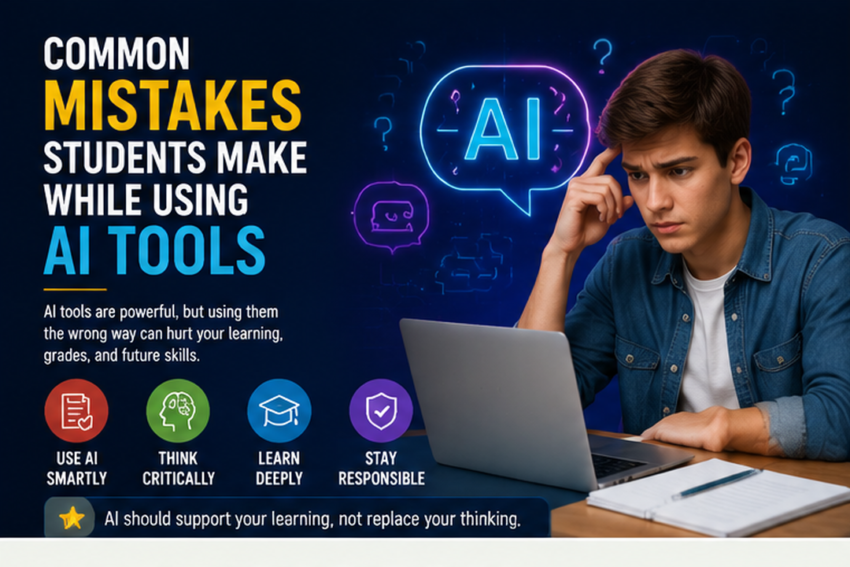
Artificial intelligence (AI) has become one of the most influential technologies in modern education. Students around the world are using AI tools to research topics, improve writing, understand difficult concepts, organize study plans, generate ideas, and enhance productivity.
Tools powered by artificial intelligence can provide valuable support when used correctly. They can explain complex subjects, suggest improvements, help with brainstorming, and offer personalized learning assistance.
However, the increasing use of AI in education has also created new challenges. Many students rely on AI tools without understanding their limitations, which can negatively affect learning, creativity, critical thinking, and academic performance.
The problem is not using AI itself. The real issue is using it incorrectly.
Understanding the common mistakes students make while using AI tools can help learners use artificial intelligence responsibly while gaining maximum benefits from this powerful technology.
The Growing Role of AI Tools in Education
AI tools have changed how students approach learning.
In the past, students depended mainly on textbooks, teachers, libraries, and online resources for information. Today, AI assistants can provide instant explanations, summaries, examples, and guidance within seconds.
Students commonly use AI tools for:
- Understanding difficult topics
- Creating study notes
- Improving grammar and writing
- Generating ideas for projects
- Practicing questions
- Learning new skills
- Organizing assignments
- Preparing presentations
When used properly, AI can act as a learning assistant that supports students.
However, AI should not replace the learning process itself.
Students still need to think, analyze, practice, and develop their own understanding.
Mistake 1: Depending Completely on AI for Answers
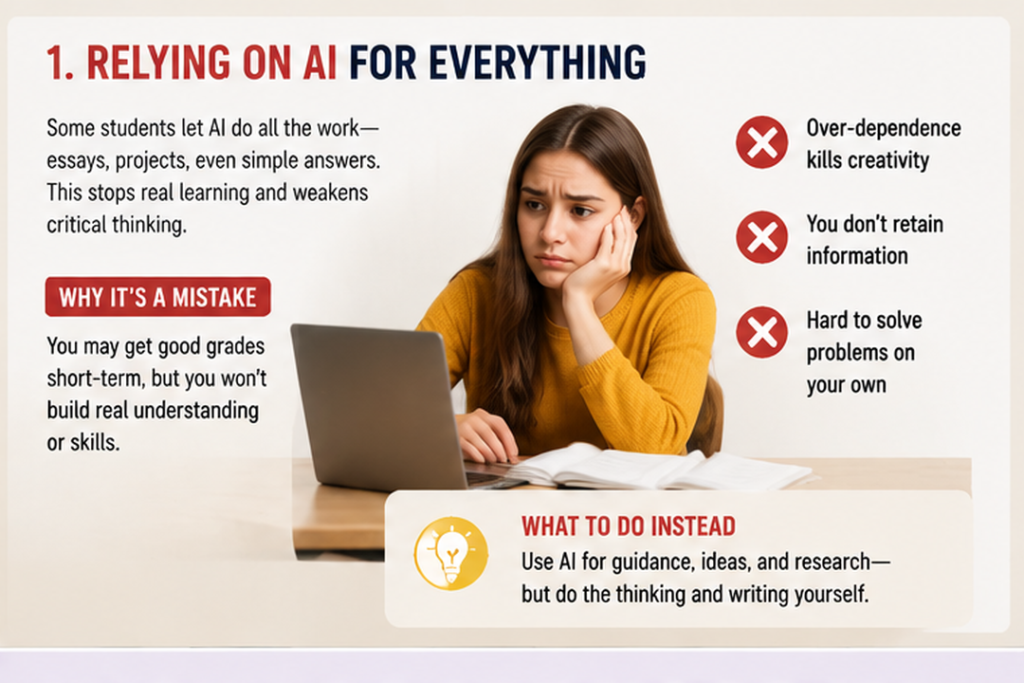
One of the biggest mistakes students make is relying completely on AI-generated answers.
AI tools can provide information quickly, but simply copying answers does not create real understanding.
Learning requires active participation.
When students allow AI to do all the thinking, they may miss opportunities to develop:
- Problem-solving skills
- Critical thinking
- Creativity
- Research abilities
- Independent decision-making
For example, asking AI to solve a mathematics problem and submitting the answer without understanding the steps may help complete one assignment, but it does not build the skills needed for future exams or real-world situations.
AI should support learning, not replace it.
Mistake 2: Copying AI Responses Without Verification
Another common mistake is assuming that every AI-generated answer is automatically correct.
Although modern AI systems are highly advanced, they can still make mistakes.
AI may sometimes:
- Provide outdated information
- Misinterpret questions
- Create incorrect facts
- Present incomplete explanations
- Generate inaccurate references
Students should always review AI responses and compare important information with reliable sources.
Developing the habit of verification is essential in the digital age.
The ability to question information is becoming just as important as the ability to find information.
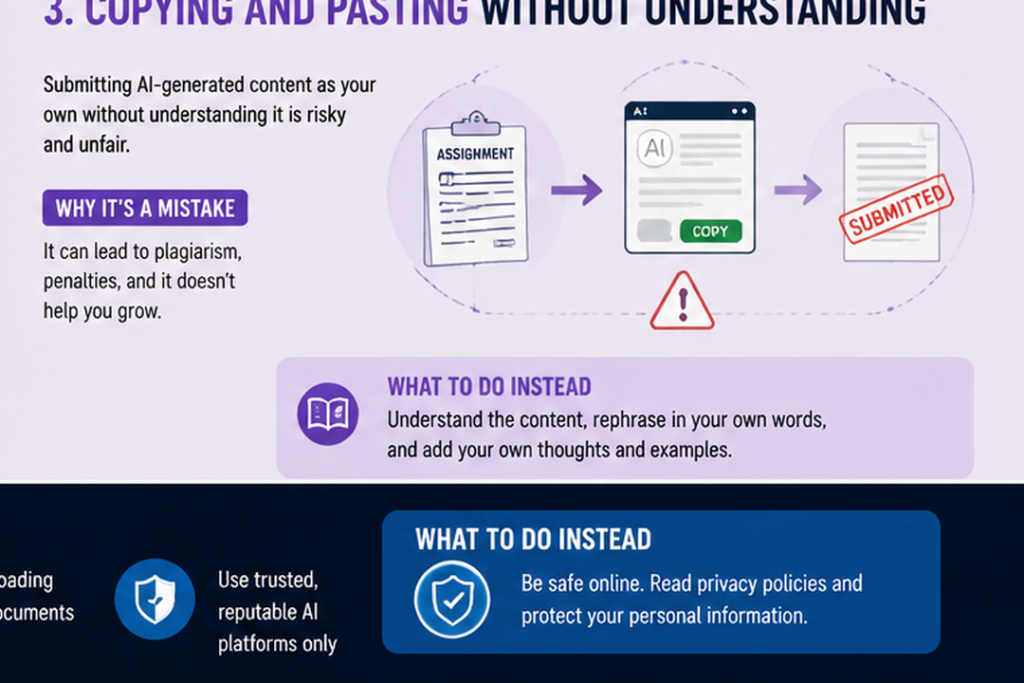
Mistake 3: Using AI for Academic Cheating
One of the biggest concerns around AI in education is misuse for academic dishonesty.
Some students use AI tools to write entire essays, complete assignments, or answer exams without contributing their own work.
While this may provide short-term benefits, it can damage long-term learning.
Education is not only about receiving grades. It is about developing knowledge, skills, and confidence.
Using AI dishonestly can lead to:
- Weak understanding of subjects
- Poor preparation for future challenges
- Academic penalties
- Loss of personal development
Responsible students use AI as a learning partner rather than a shortcut.
Mistake 4: Not Learning the Basics Before Using AI
AI tools can make many tasks easier, but students still need strong foundational knowledge.
For example, a student learning programming should understand basic concepts instead of depending completely on AI-generated code.
Similarly, students learning writing should understand grammar, structure, and communication principles rather than simply asking AI to create everything.
Without basic knowledge, students may struggle to identify mistakes in AI-generated content.
Strong foundations allow students to use AI more effectively.
Mistake 5: Asking Poorly Written Questions
The quality of AI responses depends greatly on the quality of instructions provided.
Many students make the mistake of writing unclear or incomplete prompts.
For example, asking:
“Explain this.”
may produce a general answer.
A better prompt might be:
“Explain photosynthesis for a Grade 8 student using simple examples and a short summary.”
Clear instructions usually produce more useful results.
Students should learn how to communicate effectively with AI tools.
This skill, often called prompt engineering, is becoming increasingly valuable.
Mistake 6: Using AI Without Developing Critical Thinking
Critical thinking is one of the most important skills students can develop.
AI can provide information, but students must evaluate whether that information makes sense.
Students should ask questions such as:
- Is this information accurate?
- Does it match reliable sources?
- Are there alternative viewpoints?
- What evidence supports this answer?
Blindly accepting AI responses can create incorrect understanding.
The future will require people who can work with AI while maintaining independent judgment.
Mistake 7: Ignoring Creativity and Original Ideas
Some students use AI so heavily that they stop developing their own creativity.
AI can generate ideas, but human imagination remains essential.
Creative thinking involves:
- Personal experiences
- Unique perspectives
- Emotional understanding
- Original problem-solving
For example, AI can suggest project ideas, but students should add their own opinions, research, and creativity.
The best results often come from collaboration between human thinking and artificial intelligence.
Mistake 8: Sharing Private Information With AI Tools
Privacy is an important concern when using AI platforms.
Students sometimes enter personal or sensitive information without considering security risks.
They should avoid sharing:
- Passwords
- Personal identification details
- Private documents
- Confidential school information
- Sensitive family information
Before using an AI tool, students should understand its privacy settings and data policies.
Responsible technology use includes protecting personal information.
Mistake 9: Using AI as a Replacement for Teachers
AI can provide explanations and learning support, but it cannot completely replace teachers.
Teachers offer:
- Human guidance
- Emotional support
- Experience-based advice
- Personalized feedback
- Classroom interaction
Students who depend only on AI may miss valuable learning opportunities.
The most effective approach is combining AI assistance with guidance from teachers, mentors, and educational resources.
Mistake 10: Not Improving After Receiving AI Feedback
AI tools can provide suggestions for improving writing, studying, or problem-solving.
However, some students simply accept AI corrections without learning from them.
For example, if AI improves grammar in an essay, students should understand what mistakes were corrected and why.
Feedback is valuable because it helps students improve future performance.
The goal should not only be creating better work today but becoming a better learner over time.
Mistake 11: Using AI Without Managing Time Properly
AI tools can increase productivity, but they can also become distracting.
Students may spend too much time experimenting with AI instead of completing actual learning tasks.
Effective AI use requires balance.
Students should decide:
- What task requires AI support
- How much assistance is needed
- When independent practice is necessary
Technology should save time, not create another source of distraction.
Mistake 12: Choosing the Wrong AI Tool
Not every AI tool is suitable for every learning goal.
Different tools may specialize in different areas, such as:
- Writing assistance
- Research support
- Mathematics explanations
- Coding help
- Language learning
- Design and creativity
Students should select tools based on their actual needs.
Using the wrong tool can lead to poor results or unnecessary dependence.
How Students Can Use AI Tools Correctly
When used responsibly, AI can become a powerful educational assistant.
Students can use AI effectively by:
Using AI for Understanding
Ask AI to explain difficult concepts in simpler language.
Using AI for Practice
Request quizzes, examples, or practice questions.
Using AI for Feedback
Ask for suggestions on improving writing, presentations, or projects.
Using AI for Brainstorming
Use AI to generate ideas before creating original work.
Using AI for Learning Support
Use AI explanations alongside textbooks, teachers, and reliable sources.
The purpose should always be improving knowledge.
Benefits of Responsible AI Use for Students
When used correctly, AI tools can provide many advantages.
Personalized Learning
AI can adapt explanations according to a student’s level and learning needs.
Faster Research
Students can explore topics and discover resources more efficiently.
Better Writing Skills
AI feedback can help improve grammar, structure, and clarity.
Increased Productivity
AI can assist with planning, organization, and study management.
Improved Understanding
Students can ask repeated questions and receive additional explanations.
The key is maintaining an active learning approach.
The Future of AI in Education
AI will likely become an increasingly important part of education.
Future learning environments may include more personalized AI tutors, intelligent learning platforms, automated feedback systems, and adaptive educational experiences.
However, the role of human skills will remain essential.
Creativity, communication, emotional intelligence, ethical thinking, and problem-solving cannot simply be replaced by technology.
The most successful students will be those who learn how to combine human abilities with AI capabilities.
AI literacy will become an important skill for future careers.
Tips for Responsible AI Usage
Students can follow these simple guidelines:
- Use AI to learn, not just to complete assignments.
- Verify important information before using it.
- Add personal ideas and creativity.
- Protect private information.
- Learn concepts instead of copying answers.
- Use AI feedback to improve skills.
- Follow school policies regarding AI use.
- Maintain independent thinking.
Responsible AI usage creates better learners and prepares students for a technology-driven future.
Conclusion
AI tools have transformed the way students learn, research, and complete academic tasks. They offer powerful opportunities for improving productivity, understanding complex topics, and developing new skills.
However, the benefits of AI depend on how students use it.
The common mistakes students make while using AI tools often involve overdependence, lack of verification, academic misuse, privacy risks, and reduced critical thinking.
AI should not replace curiosity, creativity, or personal effort. Instead, it should serve as a supportive tool that helps students become more effective learners.
The future of education will not belong to students who simply use AI the most. It will belong to students who understand how to use AI wisely, responsibly, and creatively.