
Learning new skills no longer requires an expensive degree, private tutor, or costly training program. Today, students, professionals, freelancers, entrepreneurs, and career changers can access a wide range of free educational resources for skill development from almost anywhere.
From online courses and video tutorials to digital libraries, coding platforms, language-learning tools, and professional communities, free learning resources can help people improve both technical and soft skills. The key is choosing reliable platforms, following a structured learning plan, and practicing consistently.
Whether you want to learn digital marketing, programming, graphic design, communication, business management, data analysis, writing, or another skill, free educational content can provide a strong starting point.
This guide explores some of the best types of free educational resources, how to use them effectively, and how they can support long-term personal and professional development.
Why Free Educational Resources Matter
Education has traditionally been associated with classrooms, textbooks, and formal institutions. While these remain important, digital learning has expanded access to knowledge.
Free learning resources can help people who may not have the time, location, or budget for traditional education.
They can be especially valuable for:
- Students who want extra learning support
- Job seekers developing employable skills
- Professionals upgrading their knowledge
- Freelancers improving specialized abilities
- Entrepreneurs learning business skills
- Career changers exploring new industries
- Lifelong learners studying personal interests
The flexibility of online education allows learners to study at their own pace and often repeat lessons as many times as necessary.
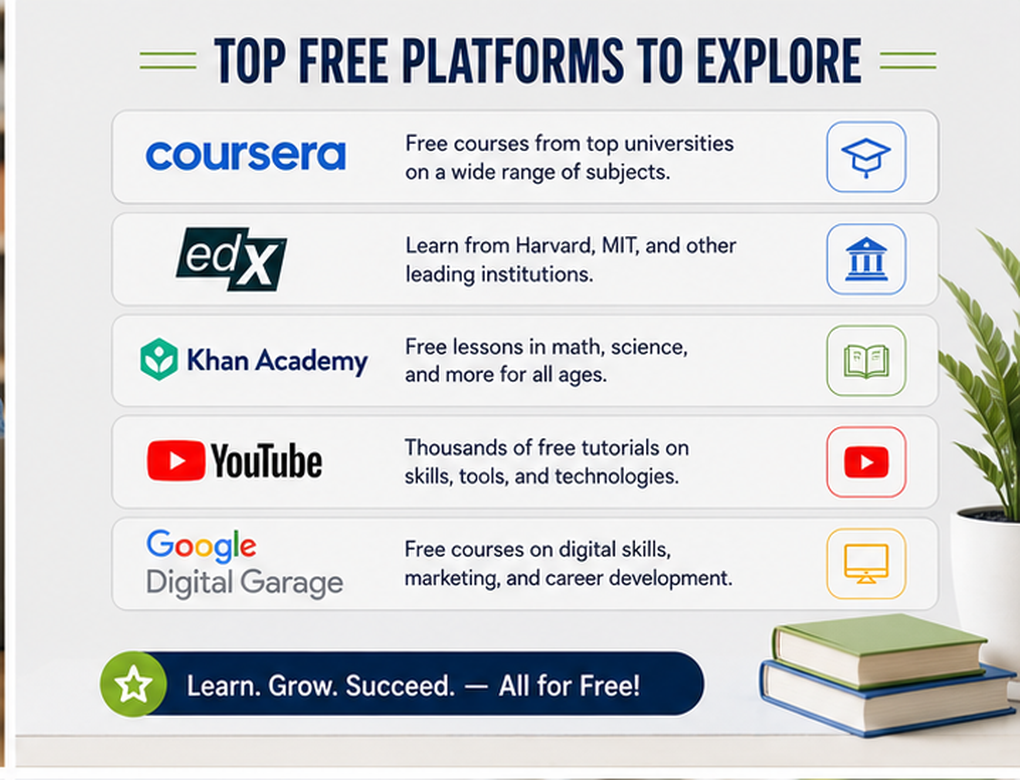
1. Free Online Courses
Online courses are among the most useful resources for structured skill development.
Many educational platforms provide free access to course materials in areas such as:
- Business
- Technology
- Programming
- Marketing
- Communication
- Finance
- Data science
- Personal development
- Languages
- Creative skills
Some platforms allow learners to access course videos and readings for free while charging only for certificates or additional features.
This makes online courses useful for people who want knowledge and practical skills without immediately paying for formal credentials.
When selecting a course, review the syllabus, instructor background, estimated duration, and practical assignments.
2. Educational Video Platforms
Video tutorials can make complex subjects easier to understand.
Educational creators publish lessons on topics ranging from basic mathematics and grammar to advanced software development and business strategy.
Video-based learning is particularly useful for visual subjects such as:
- Graphic design
- Photography
- Video editing
- Coding
- Excel
- Digital marketing
- Web development
- Drawing
- Public speaking
The major advantage is flexibility. Learners can pause, rewind, repeat difficult sections, and follow demonstrations step by step.
However, quality varies significantly between creators. It is best to compare several trusted sources rather than relying on one video.
3. Open Educational Resources
Open Educational Resources, commonly known as OER, include learning materials that are freely available for educational use.
These resources may include:
- Textbooks
- Lecture notes
- Course modules
- Worksheets
- Research materials
- Presentations
- Practice exercises
OER can be particularly helpful for students who want deeper academic understanding without purchasing expensive textbooks.
Teachers and trainers may also use open educational content to supplement their own lessons, depending on the material’s licensing conditions.
4. Digital Libraries and Free E-Books
Reading remains one of the most effective ways to build knowledge.
Many digital libraries provide free access to books, academic materials, reference documents, and public-domain publications.
These resources can support skill development in areas such as:
- History
- Literature
- Business
- Economics
- Philosophy
- Science
- Communication
- Writing
- Personal development
Learners should combine reading with note-taking and practical application.
Simply reading several books does not automatically build a skill. Knowledge becomes more useful when it is applied through projects, exercises, discussions, or real-world tasks.
5. Free Coding Platforms
Programming is one area where free educational resources are particularly strong.
Beginners can find interactive lessons covering languages and technologies such as:
- HTML
- CSS
- JavaScript
- Python
- SQL
- Java
- Web development
- Data analysis
Interactive coding platforms allow learners to write code directly while completing guided exercises.
This immediate practice can be more effective than watching tutorials alone.
A good coding-learning strategy is to study a concept and then use it in a small project.
For example, after learning HTML and CSS, create a simple personal webpage instead of immediately moving to another course.
6. Language-Learning Resources
Learning another language can support travel, education, communication, and career development.
Free language-learning resources may include:
- Vocabulary exercises
- Grammar lessons
- Listening activities
- Pronunciation practice
- Flashcards
- Language exchange communities
- Podcasts
- Video lessons
Consistency is particularly important for language learning.
Studying for a short period every day is often more effective than studying for several hours only once a month.
Learners should also practice speaking and listening rather than focusing exclusively on grammar.
7. Podcasts for Learning
Educational podcasts provide a convenient way to continue learning during daily activities.
People can listen while commuting, walking, exercising, or completing routine tasks.
Topics may include:
- Entrepreneurship
- Technology
- Science
- Psychology
- Productivity
- Career development
- Finance
- History
- Marketing
Podcasts are useful for gaining new perspectives and understanding industry trends.
However, they are usually better as a supplementary learning resource rather than a replacement for structured courses and hands-on practice.
8. Free Webinars and Online Workshops
Organizations, educational institutions, and industry professionals frequently offer free webinars.
These sessions may cover new technologies, workplace skills, industry developments, or practical techniques.
Webinars can also provide opportunities to learn directly from professionals working in a particular field.
Unlike pre-recorded content, live workshops may allow participants to ask questions and interact with instructors.
Keep a notebook during webinars and write down important ideas, useful tools, and actions you want to try afterward.
9. Professional Blogs and Industry Websites
Professional blogs can help learners stay informed about changes within an industry.
For example, someone learning digital marketing can follow reputable marketing publications, while a software developer can read official technical documentation and engineering blogs.
Blogs are particularly useful for fields that change quickly.
Courses may take time to update, while industry websites can publish information about new tools, techniques, regulations, and trends more rapidly.
However, always evaluate the credibility of the author and source.
10. Practice Platforms and Online Exercises
Skills improve through practice.
Free practice websites can provide exercises in areas such as:
- Mathematics
- Programming
- Typing
- Writing
- Grammar
- Data analysis
- Interview preparation
- Language learning
Practice allows you to identify weaknesses that may not be obvious while simply watching lessons.
If you repeatedly struggle with a particular concept, return to the learning material and study that area again.
11. Free Templates and Project Examples
Templates can accelerate learning by showing how real work is structured.
For example, business learners may use free templates for:
- Business plans
- Marketing plans
- Budgets
- Project schedules
- Presentations
- Resumes
Designers may study sample layouts, while programmers can explore example projects.
The goal should not be to copy templates without understanding them.
Instead, analyze how they are organized and then create your own version.
12. Online Communities and Discussion Forums
Learning alone can sometimes be difficult.
Online communities allow learners to ask questions, discuss problems, share projects, and receive feedback.
Communities exist for almost every major field, including coding, design, writing, entrepreneurship, marketing, and language learning.
Participating in a community can expose you to real-world problems that courses may not cover.
However, advice from public forums should be evaluated carefully. Not every answer is accurate or suitable for every situation.
For technical or professional questions, compare community advice with reliable documentation or authoritative sources.
13. Free Certification Learning Paths
Some organizations provide free training programs that prepare learners for professional certifications.
The training itself may be free even when the formal certification exam is paid.
These learning paths can be valuable because they often follow a structured curriculum.
Certification-focused learning is particularly common in areas such as:
- IT support
- Cloud computing
- Cybersecurity
- Digital marketing
- Project management
- Data analytics
Even if you do not immediately take the exam, following a certification curriculum can help organize your learning.
14. Learn Through Real Projects
One of the most valuable free educational resources is experience.
Once you understand basic concepts, start creating real projects.
For example:
If you are learning writing, start a blog.
If you are learning graphic design, create sample brand materials.
If you are learning programming, build a small application.
If you are studying marketing, create a mock campaign.
If you are learning data analysis, analyze a public dataset.
Projects force you to solve problems independently and reveal gaps in your knowledge.
They also provide examples of your skills that can later become part of a portfolio.
15. Free Productivity and Study Tools
Learning becomes easier when information is organized properly.
Free digital tools can support note-taking, task management, flashcards, calendars, and study planning.
Useful categories include:
- Note-taking applications
- Digital flashcards
- Task-management tools
- Cloud documents
- Calendar applications
- Focus timers
You do not need a complicated productivity system.
A simple weekly learning schedule is often enough.
For example, you could dedicate three days to lessons, two days to practice, and one day to reviewing what you learned.
How to Choose Reliable Educational Resources
Free does not automatically mean high quality.
Before investing significant time in a resource, evaluate it carefully.
Ask questions such as:
- Who created the material?
- Does the instructor have relevant knowledge?
- Is the information current?
- Does the course include practical exercises?
- Are the lessons logically organized?
- Does the resource match my skill level?
For technical subjects, official documentation and recognized educational institutions are generally strong starting points.
For career-related learning, resources created by experienced practitioners can also be valuable.
Create a Skill Development Plan
Random learning can be enjoyable, but structured learning usually produces better results.
Start by defining one clear goal.
For example:
Goal: Learn basic web development.
Then divide the goal into smaller steps:
- Learn HTML.
- Learn CSS.
- Learn basic JavaScript.
- Build a simple website.
- Improve the website through practice.
- Create additional projects.
This approach helps prevent the common problem of constantly starting new courses without finishing anything.
Avoid Tutorial Overload
A major challenge in online learning is consuming too much educational content without practicing.
Watching 100 programming tutorials does not necessarily make someone a programmer.
Similarly, reading dozens of marketing articles does not automatically develop practical marketing skills.
Use a simple rule:
Learn → Practice → Review → Improve
After every major lesson, complete a practical exercise.
This turns passive information into usable knowledge.
How Free Learning Can Improve Career Opportunities
Skill development can improve employability when learning is connected with practical ability.
Employers and clients often want evidence that a person can perform the required work.
Therefore, combine online learning with:
- Projects
- Portfolios
- Practical exercises
- Internships
- Volunteer work
- Freelance assignments
A person learning data analysis, for example, could create a portfolio containing several data projects rather than simply listing online courses.
Practical evidence can demonstrate how knowledge is applied.
Free Resources for Soft Skills
Technical knowledge is important, but employers also value soft skills.
Free resources can help improve abilities such as:
- Communication
- Leadership
- Time management
- Teamwork
- Problem-solving
- Critical thinking
- Negotiation
- Presentation skills
These skills are useful across industries and can improve both workplace performance and career development.
Practice soft skills in real situations whenever possible.
For example, improve presentation skills by delivering presentations rather than only watching videos about public speaking.
Advantages of Self-Paced Learning
One of the biggest benefits of free educational resources is control over your schedule.
Traditional classes may require learners to follow fixed times.
Self-paced learning allows you to study early in the morning, after work, on weekends, or whenever your schedule permits.
You can also spend more time on difficult concepts and move quickly through topics you already understand.
This flexibility makes online education particularly suitable for working professionals and people balancing multiple responsibilities.
Common Mistakes to Avoid
One mistake is trying to learn several unrelated skills at the same time.
This can divide attention and make progress difficult to measure.
Choose one primary skill and focus on it for a reasonable period.
Another mistake is constantly switching courses.
Different instructors may explain the same concepts differently, creating unnecessary confusion for beginners.
Select one main learning path and use other resources only when additional explanation is needed.
Finally, do not focus too heavily on certificates.
Certificates can be useful, but actual ability and practical experience are often more important.
How to Stay Motivated While Learning Online
Motivation naturally changes over time.
Instead of depending entirely on motivation, build a routine.
Set small weekly goals.
For example:
- Complete two lessons
- Practice for three hours
- Finish one small project
- Review one difficult topic
Track your progress.
Seeing completed projects and improved abilities can provide stronger motivation than simply counting the number of courses started.
Final Thoughts
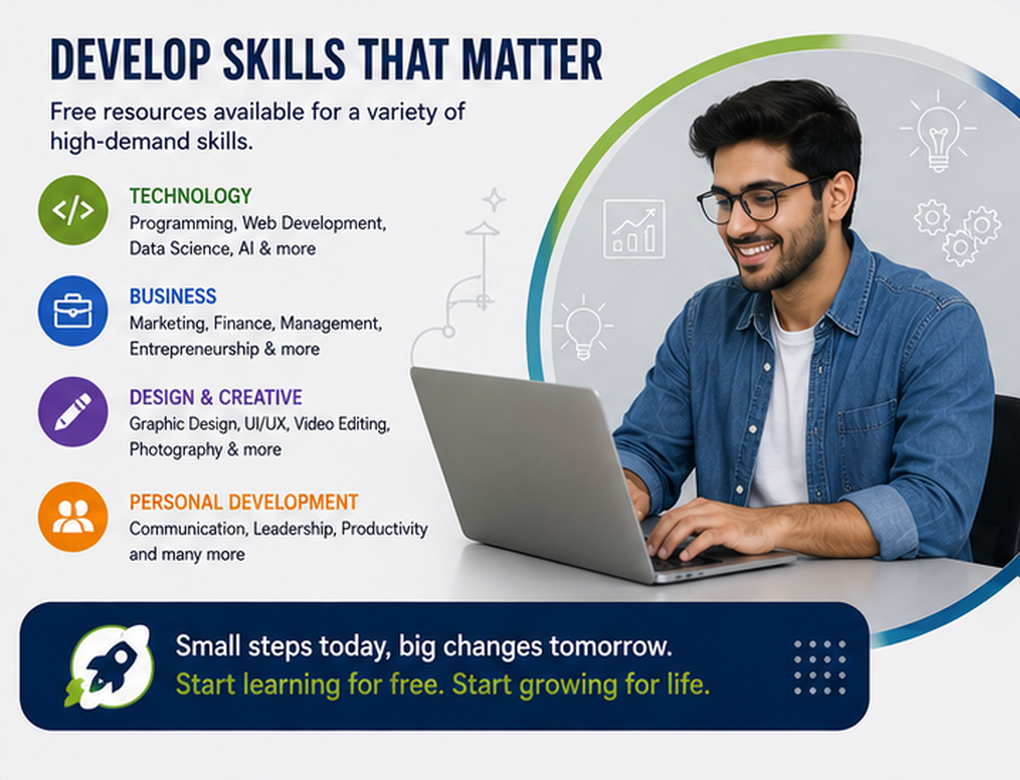
Access to free educational resources for skill development has created new opportunities for people around the world.
Online courses, educational videos, open textbooks, coding platforms, digital libraries, webinars, communities, and practical projects make it possible to start learning valuable skills with little or no financial investment.
However, having access to information is only the first step.
Real skill development requires consistency, practice, and patience.
Choose a clear goal, follow a structured learning path, practice what you learn, and gradually build real projects.
You do not need to learn everything at once.
A few focused hours each week can create meaningful improvement over time. By combining reliable free resources with consistent effort, you can strengthen existing skills, explore new career opportunities, and continue learning throughout your personal and professional life.